Most retail tenants we build for in Naperville spend months on the inside of the space: the layout, the fixtures, the checkout counter, the fitting rooms. The outside gets a line in the budget that says “signage” and a sketch from the sign shop. Then, a few weeks before opening, someone learns that the sign needs its own permit, that the letters they ordered are too big for their frontage, or that the dark film they planned for the front windows is the one thing the City’s design guidelines say not to do.
We build retail, restaurant and office spaces across Naperville and DuPage, Will and Kane counties, and the storefront is where a build-out meets the public. This guide covers how Naperville regulates that outside face of a retail space: the sign code, the permit, window graphics, awnings, sidewalk signs and the design review that comes with any exterior change. It is written for the business owner, not the sign shop. Every number below comes from the City’s own sign code (Title 6, Chapter 16 of the Naperville Municipal Code) or the City’s published permit pages, and the City’s staff have the final word on your specific address.
Your Sign Is a Separate Permit From Your Build-Out
Naperville treats the interior build-out and the sign as two different applications. The tenant build-out permit covers changes to the space and to the building’s exterior and systems. The City’s New Business Resource Guide says it is required for businesses that intend to modify the interior or exterior of the building they will occupy. The sign is a separate sign permit, and the City’s sign permit page is direct about it: a permanent sign permit is required for all wall and monument signs.
The permanent sign application has to include, before the City starts processing it:
- a scaled drawing of the sign with all dimensions
- a site plan showing the building and the sign in relation to streets, parking and entrances
- for a wall sign, a scaled drawing of the building elevation where it will go, with dimensions
- for a lit sign, a completed Electricians Certification Form, plus an application for new electric service if the sign needs it
Each sign carries an application fee and an inspection fee, with an additional fee for inspecting electrical signs. Once a complete application is in, the City says staff will grant or deny it within 14 calendar days. Applications go through the City’s Civic Access online portal. Two weeks is not long, but it is two weeks that only starts once the drawings exist, and most sign shops will not fabricate until the permit is approved. Put the sign on the same schedule as the build-out, not after it.
How Big Your Wall Sign Can Be
For most retail tenants the sign that matters is the wall sign over the entrance. Naperville’s rule is simple to state. For a facade with street frontage, or a facade facing an off-street parking lot where customers can get into the building, wall, awning and canopy signs combined may total up to 1.5 square feet for each linear foot of facade.
So a storefront with 24 feet of frontage has a combined budget of 36 square feet. That covers the main wall sign, any lettering on an awning, and any canopy sign together, not 36 square feet each. A few other rules shape what goes in that budget:
- Back and side walls. A facade that faces a parking area where customers cannot get in is limited to half of the maximum.
- Roofline. Signs may not extend above the roofline or parapet of the building.
- Architecture. Wall signs have to sit substantially parallel to the wall and must not interrupt architectural details.
- Raceways. If the raceway behind channel letters is visible, it has to match the color of the building.
- Upper floors. In a multi-story, multi-tenant building, all tenants above and below the first floor share one combined 1.5-square-foot-per-foot allowance on facades facing a public right-of-way. First-floor tenants get their own.
Measure your frontage before the sign shop designs anything. Franchise brand packages are often drawn for a standard storefront width, and a sign sized for 30 feet will not fit a 20-foot bay.
Lighting the Sign
Internal, external and bare-bulb lighting are all allowed in Naperville, with limits. The code caps illuminated signs at 30 foot-candles measured 4 feet from the sign, and prohibits flashing signs outright, along with anything that rotates, moves or gives the appearance of movement. That rule also covers attention-getters like spinners, streamers and balloons unless the chapter expressly allows them.
The electrical side runs through the permit. A lit sign needs the electrician’s certification with the application, and if the sign needs a new circuit, that circuit belongs in the build-out’s electrical drawings. Naperville runs its own electric utility, so if the sign needs new service, that application goes to the City as well. Have the sign’s power drop, timer or photocell, and the location of the junction box behind the sign agreed between the sign shop and your electrician before the facade is closed up.
Window Graphics, Blade Signs and Awnings
Window signs do not need a permit in Naperville, but they are capped. They may cover at most 75 percent of a single window pane, and no more than 50 percent of the total window area on each storefront elevation. A full wrap on one pane can work. Wrapping every pane will not.
Blade signs, the small projecting signs over a sidewalk, are allowed at up to 8 square feet per side, one per business per qualifying facade. The bottom of the sign must be at least 8 feet above the sidewalk, and it may project no more than 6 feet from the building. A blade sign is fixed to the facade, so plan the blocking or anchors behind the wall while the wall is open.
Awnings and canopies must keep at least 8 feet of clearance from grade to their lowest edge, and are limited to two colors, logos excepted. Lettering on an awning counts against the same combined sign allowance as the wall sign.
The City’s citywide Building Design Guidelines go further on awnings than the sign code does. They encourage fabric awnings, preferably matte canvas, mounted over individual window and door openings. Continuous awnings that run across several openings are strongly discouraged, as are high-gloss, illuminated and plastic awnings. Metal or glass awnings may be acceptable outside the downtown area if they suit the building.
Sidewalk Signs and Temporary Banners
An A-frame sidewalk sign does not need a permit, within limits. Outside downtown, you get one sidewalk sign up to 6 square feet and 5 feet tall, placed within 5 feet of the building entrance and displayed only during business hours. It may not sit in the public right-of-way unless the code says otherwise.
Downtown has its own sidewalk-sign rules. Signs must leave at least 4 feet of clear walking space, stay within the footprint of your own tenant space, and may not be lit. They come in at the end of the business day, during high winds and heavy snow, and during snow removal.
Grand-opening banners and other temporary signs are a different matter: they do need a permit. Each temporary sign needs its own permit, and a business may display temporary signs for no more than four weeks per calendar year, a full week at a time. The four weeks can run back to back or be spread through the year. The City says most temporary sign permits can be approved when you apply. If your opening banner and a fall sale banner both matter to you, count the weeks before you use them.
Taking Over a Space With an Old Sign
Retail tenants often inherit a building sign or a slot on a shopping center’s monument sign, and assume swapping the face is just maintenance. The code mostly agrees, but not always.
- Like-for-like panels. Replacing an individual tenant panel on a multi-tenant sign with a like-for-like panel is exempt from a permit.
- Nonconforming signs. Many older signs in town no longer meet the current code. On one of those, ordinary repairs and panel swaps are allowed, except when the change in the displayed message is due to a change of business tenant. The code also bars any repair or alteration that makes a nonconforming sign bigger, and requires a sign moved to a new spot to fully conform.
- Dark signs. A nonconforming sign that has been discontinued for 180 days in a row has to be removed, and whatever replaces it must meet the current code.
Some sign types are prohibited citywide, including pole signs (except tollway corridor signage), off-premise commercial signs, billboards and portable signs other than sidewalk signs. If the space you are looking at relies on an older sign, ask the landlord whether it conforms, and ask the Planning Division before you count on it in your lease.
Downtown Naperville Plays by Stricter Rules
Properties zoned B4 and B5, the downtown Central Business District, are one of the code’s Areas of Special Control. The same 1.5-square-feet-per-linear-foot allowance applies, but it is counted for each qualifying facade, and downtown qualifying facades include streets, sidewalks, alleys, parking lots and the West Branch of the DuPage River. Other downtown rules:
- Changeable-copy signs, electronic message boards and new ground signs are prohibited in the downtown district.
- External lighting, internally lit individual channel letters and bare-bulb signs are allowed. Internally lit box signs are allowed only as an accessory to a primary sign, with dimensional letters, unless the Zoning Administrator approves otherwise.
- In a multi-tenant building, upper-floor tenant signs must be spread across the facade near each tenant’s space rather than clustered, and the Zoning Administrator reviews the locations.
If your space is in or next to the historic district, our guide to remodeling in Naperville, Geneva and St. Charles historic districts covers the extra review that applies there.
Changing the Storefront Itself Brings Design Review
Replacing a storefront system, adding an entrance, re-cladding a facade or changing window openings is exterior work under the build-out permit, and it brings in the City’s Building Design Guidelines. The guidelines state that all non-residential and mixed-use buildings that require building permits are subject to design review based on them. For a retail tenant, the points that come up most:
- Transparency. For retail uses, the guidelines call for at least 50 percent of the ground-floor facade to be transparent. Ground-level glass should be clear and unobstructed, and mirrored and dark-tinted glass are not acceptable. If you are thinking of tinted film for privacy or to protect merchandise from sun, raise it with the City first.
- Signs and architecture. Signs should not cover or interrupt the facade’s architectural detail or project above the roofline. The guidelines suggest retail signs can go on awnings over the entry or windows.
- Materials. Brick and stone are the preferred primary and accent materials, and the guidelines favor durable, textured materials at a human scale.
None of this usually stops a storefront project, but it does shape what gets drawn. A facade design that ignores it tends to come back with comments, and comments cost weeks.
How to Run It in Naperville
The simplest way to get the sign and storefront right the first time is to ask before anything is fabricated. Naperville holds in-person pre-application meetings for businesses moving into existing commercial space every Tuesday from 8:30 to 9:30 a.m., with Planning, the Building Division, the Fire Department and the Electric Utility in the room. The City recommends meeting with the Planning Division first, and notes that Planning staff can advise on building signage requirements and on the special requirements that apply downtown. The Planning Division can also be reached at (630) 420-6694 or planning@naperville.il.us, and general permit questions go to the TED Business Group at (630) 420-6100.
Bring a photo of the storefront, your frontage measurement, the sign shop’s concept and your landlord’s sign criteria if the center has them. Most shopping centers have their own sign rules in the lease, and those apply on top of the City’s.
Outside Naperville, every town we work in has its own sign ordinance and its own permit desk, and the allowances differ. Our DuPage and Will County permit guide covers how permitting runs in the other towns, and our location pages for Aurora, Wheaton and Downers Grove cover the projects we do there. Check that town’s code before you assume Naperville’s numbers apply.
A Sequence That Works
- Before you sign the lease, measure the frontage, photograph the existing sign and ask the landlord for the center’s sign criteria. Ask whether the existing sign conforms to the current code.
- Work out your sign budget: 1.5 square feet per linear foot of qualifying facade, shared among wall, awning and canopy signs.
- Take the storefront and sign concept to a Tuesday pre-application meeting, Planning first.
- Put the sign’s power, blocking and anchors into the build-out drawings so the wall is ready for it.
- Submit the sign permit with complete drawings as early as the design allows, and allow 14 days for a decision before the sign shop can fabricate.
- Plan your four weeks of temporary banners around the opening, and keep window graphics within the 50 percent limit.
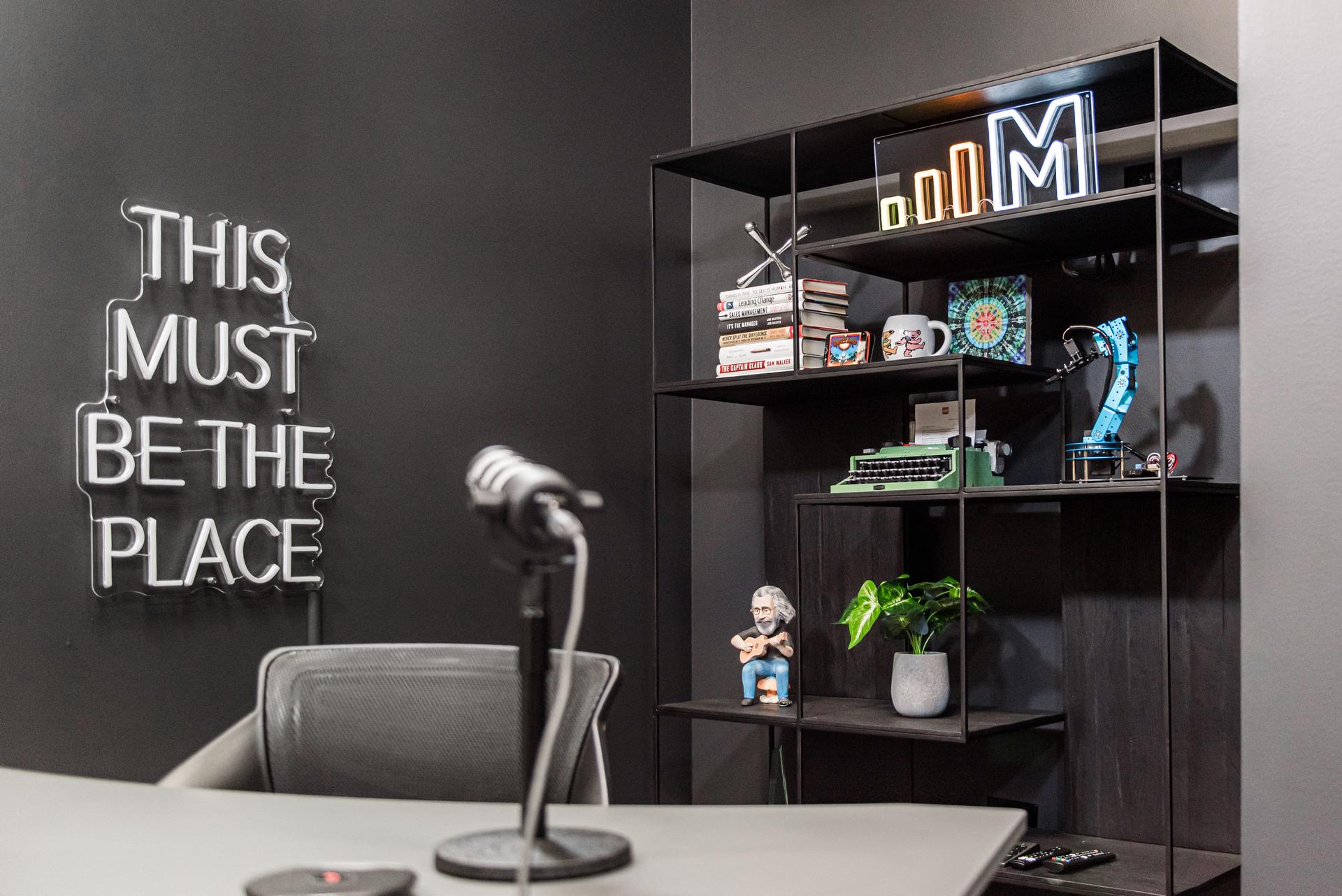
If you are weighing a retail space, we will walk it with you and tell you what the storefront, the sign and the interior will take, including the code items that change the budget. That is the work of our retail space remodeling and tenant improvement teams, with commercial renovation covering the larger reworks. On the MRG commercial build-out in Naperville, the brand showed up in the neon signage and feature walls inside the space; on a retail storefront, the same brand has to work within the City’s sign allowance outside.
Frequently Asked Questions
How big can a wall sign be on a Naperville storefront?
Under Naperville’s sign code, wall, awning and canopy signs combined may total up to 1.5 square feet for each linear foot of facade on a facade with street frontage or facing a parking area customers can enter from. A 24-foot storefront therefore gets 36 square feet in total. A facade facing a parking area with no customer entrance gets half that, and no sign may extend above the roofline or parapet.
Can I just put my name on the existing shopping center sign?
Often, yes. Replacing an individual tenant panel on a multi-tenant sign with a like-for-like panel is exempt from a permit in Naperville. The exception is an older sign that no longer conforms to the current code: on a nonconforming sign, panel changes are allowed as ordinary maintenance except when the change is due to a change of business tenant. Ask the landlord whether the sign conforms, and confirm with the City’s Planning Division before you count on it.
Do window graphics need a permit in Naperville?
No, window signs are exempt from a sign permit, but they are limited to 75 percent of any single window pane and 50 percent of the total window area on each storefront elevation. Separately, the City’s Building Design Guidelines call for clear ground-floor glass on retail storefronts and treat mirrored and dark-tinted glass as not acceptable.
How long does a Naperville sign permit take?
The City says staff will grant or deny a permanent sign permit within 14 calendar days of receiving a complete application. Complete means the scaled sign drawing, a site plan, a building elevation for wall signs and, for lit signs, the Electricians Certification Form. Most temporary sign permits can be approved at the time of application.
Have a question we have not covered here? Our remodeling and build-out FAQ answers the broader set, or tell us about the space you are looking at and we will tell you honestly what the storefront and build-out are going to take.