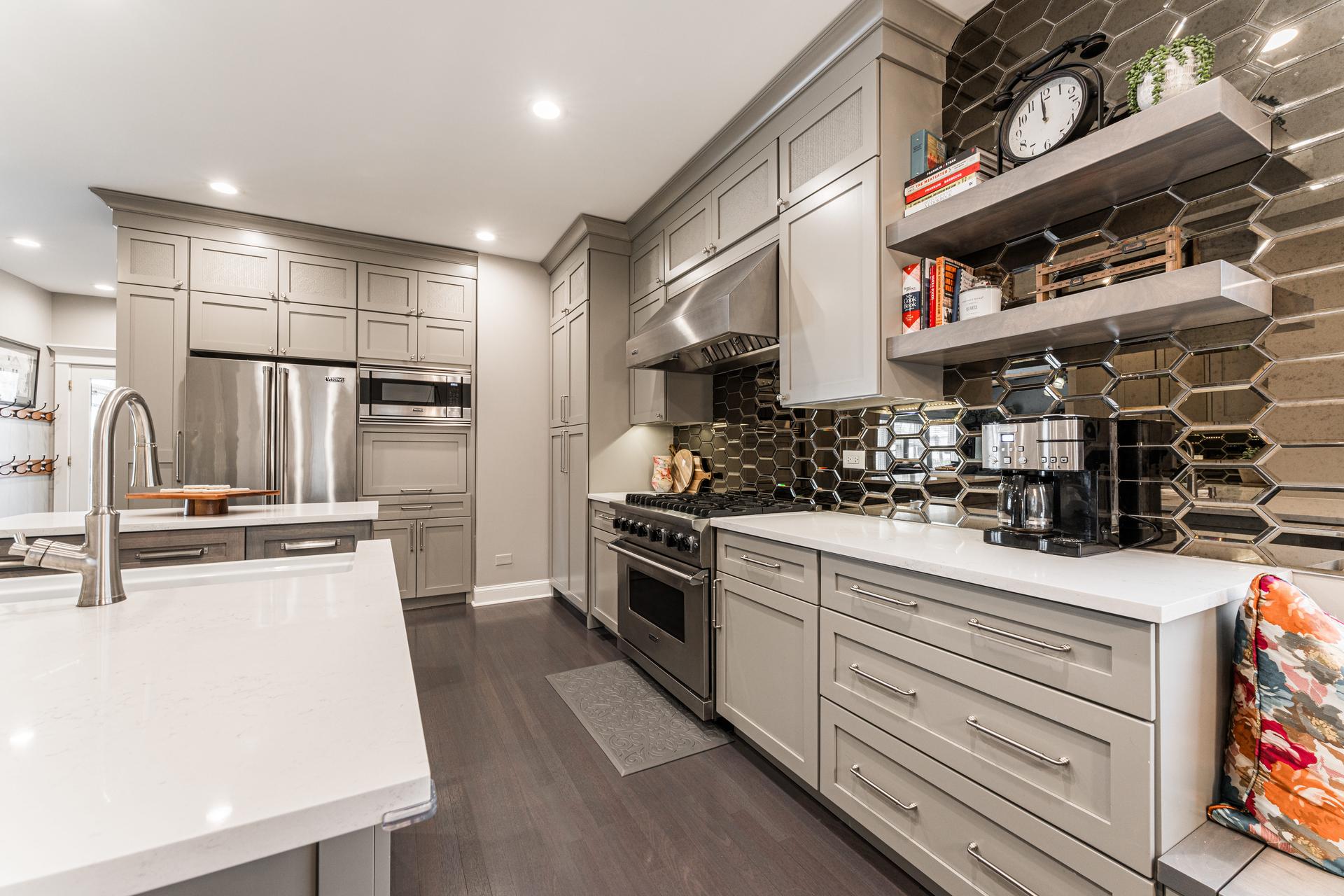
We've installed all three in recent projects — Viking in the Dillman kitchen in Plainfield, Wolf in the Foxtrail kitchen in Naperville, and Thermador in the Eastcliff kitchen in Shorewood. This isn't a review based on spec sheets or manufacturer claims. It's based on what we see during installation, what clients report six months and two years later, and what the service records look like when something eventually needs attention.
The short answer before we get into the details: Wolf is the safest choice for most homeowners. Thermador is the best value, especially if the free dishwasher promotion is active. Viking is for buyers who specifically want pro-level BTU output and are prepared for the trade-offs. All three are genuinely better than consumer-grade appliances. The differences between them matter — but they matter most to specific types of cooks, and which one is right for you depends on how you actually cook.
How to Think About Pro Appliance Comparisons
Consumer reviews of professional kitchen appliances are often written by people who've owned the product for three months. That's not enough time to know what you're buying. The questions that actually matter are: How does it perform on the tasks I cook most often? What's the service infrastructure in the Chicago metro area? What do repairs look like after 3–5 years of regular use? What are the installation requirements that will affect my kitchen design?
We're in a position to answer some of these better than most: we've installed the equipment, we sometimes get called back when something goes wrong, and we talk to our clients for years after projects finish.
Wolf: The Benchmark
Wolf has been the residential pro-range standard since the early 1990s. The brand is owned by Sub-Zero Group, based in Madison, Wisconsin — the same company that makes Sub-Zero refrigerators. That ownership matters operationally because the service infrastructure for both brands is strong throughout the Chicago metro. There are factory-certified Wolf/Sub-Zero service technicians in DuPage County specifically, which matters more than people realize until they need a repair.
The Dual-Stack Burner
Wolf gas ranges use a dual-stack sealed burner — two concentric burner rings that operate independently. The inner ring alone produces a very low, steady simmer (around 400 BTU) that holds a sauce or chocolate at a gentle bubble without scorching. The outer ring brings total output to 15,000–18,000 BTU, which is real cooking heat. The transition between these two modes is smooth and predictable in a way that single-ring burners at any price point don't match. This is Wolf's genuine technical differentiator. If your cooking regularly involves sustained low-heat work — sauces, braises, tempering chocolate — it's meaningful. If your stovetop mostly boils pasta and sears the occasional steak, you'll barely notice the difference between Wolf and Thermador.
Wolf in Practice: The Foxtrail Kitchen, Naperville
The Foxtrail homeowners selected a Wolf 36" dual-fuel range (6 burners, dual-convection oven) and a Wolf microwave drawer for the island. Installation was textbook — Wolf's installation documentation is detailed, accurate, and matches the actual product, which we appreciate more than homeowners would guess. Two-plus years out: zero service calls. The range performs exactly as purchased. Oven temperature is accurate (oven calibration drift is a complaint we hear from clients with other brands; we've never heard it from Wolf owners). Burner igniters still crisp. That reliability is consistent with what we hear across multiple Wolf installations.
Wolf Pricing (2025)
- 36" dual-fuel range: $7,200–$8,400
- 48" dual-fuel range: $12,500–$14,000
- 30" single wall oven: $3,800–$4,600
- 36" gas cooktop: $3,200–$3,800
- Full suite (range, hood, wall oven, dishwasher): $18,000–$28,000 depending on configuration
Wolf Is Best For
Homeowners doing a $80,000–$150,000+ kitchen who want proven, reliable performance with the strongest local service backstop. Cooks who specifically value the simmer control. Buyers for whom "Wolf kitchen" carries resale and lifestyle meaning. If you're uncertain which brand to choose and value confidence over optimization, Wolf is the safe call.
Thermador: Best Value in the Category
Thermador is owned by BSH (Bosch Siemens Hausgeräte), which also manufactures Bosch and the ultra-premium Gaggenau brand. The German engineering lineage shows in the product — Thermador is precise and thorough in a way that's slightly different in character from the American pro-kitchen aesthetic of Wolf and Viking. It also shows in how the company supports its products: the BSH service network in the Chicago metro area is solid and well-organized.
The Star Burner
Thermador's signature is the five-pointed Star Burner. Rather than a circular flame ring, the burner creates five flame points in a star pattern, producing more even heat distribution across the bottom of a pan. In practice, you move pans less during sautéing — hot spots are reduced because the heat footprint is wider. This is a genuine engineering difference, not marketing differentiation. Thermador's ExtraLow simmer mode is also excellent — among the best sustained low-heat performance in the category.
Thermador in Practice: The Eastcliff Kitchen, Shorewood
The Eastcliff clients selected a Thermador 36" dual-fuel range and a wall oven package. The deciding factor in the brand choice was the Thermador free dishwasher promotion. At the time of purchase, qualifying suites (range, hood, refrigerator) included a Thermador dishwasher at no additional cost — retail value $1,400. The Eastcliff homeowners came in $3,200 under their appliance budget compared to an equivalent Wolf suite, and redirected those savings toward higher-specification countertop material. One year out: one warranty service call for a minor oven door seal issue, resolved promptly under warranty with no friction. The BSH warranty service experience in the western suburbs is good.
Thermador Pricing (2025)
- 36" dual-fuel range: $6,800–$8,000
- 48" dual-fuel range: $11,500–$13,500
- Freedom induction cooktop (36"): $4,200–$4,800
- 30" single wall oven: $3,400–$4,200
- Free dishwasher promotion: Periodically active on qualifying suites — verify current terms with your dealer before purchasing, as the specific qualifying products change
Thermador Is Best For
Buyers who want professional cooking performance at the best value in the category. Homeowners seriously considering induction cooking — Thermador's Freedom induction cooktop is one of the best residential induction products available. Clients doing a $65,000–$100,000 kitchen who want to allocate appliance savings to other finishes. Anyone for whom the free dishwasher promotion makes the financial case straightforward.
Viking: Maximum Power, Known Trade-Offs
Viking essentially created the residential pro-style range category. The company launched in Greenwood, Mississippi in 1984, and their original commercial-style ranges — open burners, heavy cast iron grates, industrial knobs — set the visual and performance standard the entire category still follows. For 15 years, a Viking range was the definitive status signal in a serious cook's kitchen.
The honest history: Viking had well-documented quality and reliability problems from roughly 2005 to 2013. Middleby Corporation acquired the brand in 2012 and invested substantially in manufacturing improvements at the Greenwood facility. The current product line, made post-2014, is significantly better than the generation that earned the poor reputation. But the reputation hangover is real, and service variability — while reduced — remains higher than Wolf or Thermador. We tell clients this directly.
Viking's Real Advantages
Power. Viking gas burners produce 800–20,000 BTU, with some configurations going higher. If you regularly cook for large groups, do serious high-heat wok cooking, or need to bring large volumes of liquid to boil quickly, this matters. Wolf and Thermador are close, but Viking is genuinely at the top of the residential BTU range. Viking also offers the widest configuration variety — 30", 36", 48", and 60" widths, with multiple burner, griddle, and grill configurations in the wider models. If you have specific equipment requirements, Viking's lineup probably has exactly what you want.
Viking in Practice: The Dillman Kitchen, Plainfield
The Dillman clients specifically wanted the Viking 48" dual-fuel range — the 6-burner-plus-griddle configuration with the electric convection oven. They cook seriously: large holiday meals for extended family, competitive-level barbecue prep, and weekend cooking as a primary hobby. The 48" Viking with the griddle is the right tool for what they do, and the alternatives don't offer it at comparable BTU output.
Installation note: the Viking 48" required 240V/40A dedicated service for the oven element and a 1" gas line, versus the 3/4" line most residential ranges use. We coordinated the electrical circuit upgrade with our electrician before the range was delivered — always confirm utility requirements with the specific model before scheduling delivery, because these are not details that can be addressed after the appliance is in the kitchen. One-plus year out: no service calls. Consistent with what we hear from Viking owners who have current-generation product.
Viking Pricing (2025)
- 36" dual-fuel range: $7,000–$8,500
- 48" dual-fuel range: $12,000–$14,500
- 30" single wall oven: $3,500–$4,500
- Full suite: $16,000–$28,000
Viking Is Best For
Serious home cooks who specifically want the 48" or 60" configuration that competitors don't offer at equivalent BTU. Buyers for whom raw power output is the primary criterion. Homeowners who've done their research on the post-Middleby quality improvements and are comfortable with the history. Not recommended for buyers who want minimum-maintenance, set-it-and-forget-it appliance performance.
Decision Framework
Choose Wolf if: You want the safest, most reliable choice with the strongest local service network. You cook sauces or other applications where the dual-stack simmer matters. You're doing a $90,000+ kitchen where the Wolf nameplate is part of the project story. You value confidence over optimization.
Choose Thermador if: You want the best value in the pro tier. You're seriously considering induction — Thermador wins that category. The free dishwasher promotion is active and makes the financial case obvious. You want German-engineered precision and are comfortable with a less well-known name.
Choose Viking if: You cook at a level where 20,000+ BTU output changes what you can do. You specifically want the 48" or larger configuration that only Viking offers at this BTU level. You've done your homework on post-2014 quality and are making the choice clear-eyed.
Whichever brand you land on, the decision has to happen early: burner output drives the ventilation spec, and a 48" range changes the cabinet run and the gas line feeding it. Sequencing those three together before demo starts is part of every kitchen remodeling project we run in Naperville and the western suburbs.
To see where the appliance decision sits in the rest of the job, including design, permits, rough-in and inspections, read our Naperville kitchen remodel process guide.
Where to Buy in the Chicago Suburbs
For appliances at this price point, we consistently recommend against big-box retailers. The right options in the western suburbs:
- Abt Electronics (Glenview): Best selection, competitive pricing, and an excellent in-home service department covering the full Chicago metro. Our default recommendation for all three brands. Their sales staff know the products well and won't oversell you.
- Pirch (Chicago): Working kitchen vignettes where you can actually cook on the appliances before buying. Worth the drive to Chicago if you're deciding between Wolf and Thermador and want to feel the difference in person.
- Always verify factory-authorized dealer status before purchasing. Warranty service routing differs between authorized dealers and grey-market sellers, which matters the first time you need a repair.
Frequently Asked Questions
Is Wolf worth the premium over Thermador for most homeowners?
In terms of raw cooking performance, the gap is smaller than the price difference suggests. Wolf's real advantages are the dual-stack simmer burner and the service network confidence that comes with the Sub-Zero Group infrastructure. For a $90,000+ kitchen project where the Wolf story matters and you're planning to stay for 10+ years, it's worth it. For a $65,000–$85,000 kitchen where budget optimization matters, Thermador with the suite promotion is the smarter call.
What range hood do I need for a pro-style range?
Minimum 1,200 CFM for a 36" pro-style range; 1,200–1,500 CFM for a 48". The hood must vent to exterior — recirculating hoods are not appropriate for pro-level BTU output. Duct sizing matters: undersized ductwork limits effective CFM regardless of the hood's rating. We design ventilation as part of the kitchen scope and run the duct calculation before selecting hood size.
What are current lead times for pro appliances?
Order well in advance. Current estimates (2025): Wolf 4–6 weeks for standard configurations. Thermador similar. Viking 3–5 weeks standard, longer for unusual configurations or colors. Sub-Zero built-in refrigerators: 8–12 weeks. We confirm lead times at the proposal stage and build them into the project timeline — we never start a kitchen and then wait for appliances.
Should I get a Sub-Zero refrigerator to match a Wolf range?
Sub-Zero is genuinely the best residential refrigeration product available — the dual-compressor design (separate compressors for fresh food and freezer zones) extends food life meaningfully and is better than anything in the consumer tier. The DuPage County service network is strong. The price premium is real: $7,000–$14,000 for built-in models. For buyers doing a $100,000+ kitchen who plan to stay in the home for 15+ years, it's a rational investment. For buyers doing a $65,000–$80,000 kitchen, a Bosch or high-end KitchenAid counter-depth refrigerator performs well at a fraction of the cost.
Is a 48" range worth it for a home kitchen?
For serious home cooks with kitchens sized to accommodate it, yes. A 48" dual-fuel or all-gas range gives you 6 or 8 burners, two ovens (often different sizes for different purposes), and a dedicated griddle or grill section. The practicality argument: if you regularly cook holiday meals for 12+ people or bake multiple things simultaneously, the second oven alone justifies the size. The vanity argument also exists — a 48" professional range is a statement piece in a kitchen. Both motivations are legitimate.
What's the difference between dual-fuel and all-gas ranges?
Dual-fuel means gas cooktop, electric oven. All-gas means both cooktop and oven run on gas. The argument for dual-fuel: electric ovens heat more evenly and offer better humidity control for baking. The argument for all-gas: simplicity, consistency, and not needing a 240V circuit where one doesn't exist. In practice, the difference matters most for serious bakers. For everyday cooking and roasting, all-gas performs well. We install both — it depends on what the client cooks.
Should I get an induction cooktop?
Induction cooktops — whether integrated into a range or as a separate surface unit — heat faster, respond faster, and are easier to clean than any gas or radiant electric surface. The tradeoff: you need induction-compatible cookware (cast iron, stainless-core, enameled cast iron all work; aluminum and copper don't). For homeowners willing to make that transition, induction is genuinely superior for everyday cooking. Wolf, Thermador, and Miele all make excellent induction surfaces. We've installed the Wolf Induction module in several recent western suburbs kitchens to excellent results.
How long do professional kitchen appliances typically last?
Well-maintained Wolf and Sub-Zero equipment regularly lasts 20–25 years. Viking, when properly serviced, is similar. The contrast with consumer appliances (typical lifespan 10–15 years for a mid-grade range or refrigerator) is real and factors into the cost analysis for long-term owners. For homeowners planning to be in their home for 15+ years, the cost-per-year math on professional appliances is better than it looks at purchase.
What's the lead time for professional appliances in the Chicago area?
This is important for project planning. Standard Wolf and Thermador configurations are typically in stock or available within 2–4 weeks through dealers like Abt. Custom colors, specific configurations, or specialty items (Wolf steam oven, Sub-Zero wine storage, Miele speed oven) can have 6–14 week lead times. We always confirm appliance availability before setting demo and cabinet installation dates — a delay in appliance delivery with cabinets installed and countertops measured is an expensive wait.